
Working Discussion on the Ústí nad Labem City Development Policy
Date: September 9, 2025
Start: 5:00 p.m.
End: 7:00 p.m.
Location: City Council Meeting Room (1st floor, Velká Hradební 2336/8, Ústí nad Labem)
Present: Jan Havránek, Aneta Šmerdová, Jiří Svoboda, Eva Fialová, Petr Nedvědický, Jiří Železný, Jaromír Hůla, Tomáš Kirbs, Jiří Sobotka, Lukáš Pokorný, Bohumil Ježek, Jaroslav Šimanovský, Jan Chmelík, Jan Kodalík, Eva Nováková, Jiří Starý, Jan Prošek, Jan Hrouda, Petr Hofman, Vojtěch Jahn, Dalibor Dařílek, Martina Žirovnická, Romana Filáčková
Minute-taker: Aneta Šmerdová, AQE advisors a.s.
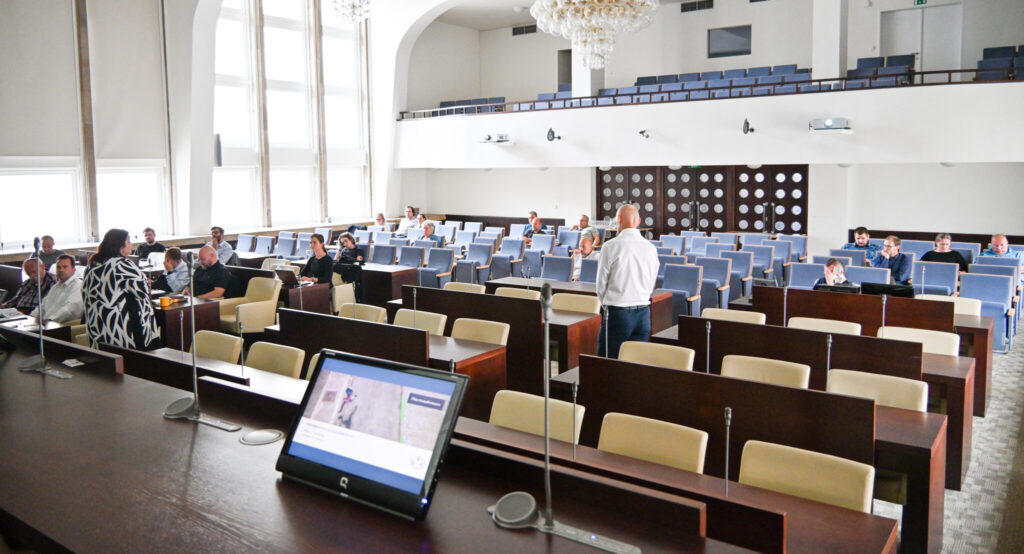
Minutes
Opening Remarks, Introduction to the Transformation Process
Eva Fialová
● Introduction to the city’s transformation process and its main pillars:
- Municipal Housing – currently the most advanced phase
- Special Economic Zone (SEZ)
- Innovative District (ID)
● The implementation and work of the Steering Committee are transparent and open to the public; information will be available on the website (launching in October 2025).
Jan Havránek
● Purpose of the meeting – working discussion.
● A progress report will be prepared for the city council.
● The presentation will be sent to all participants.
Progress of work
● Follows up on the approved Development Policy.
● We are conducting detailed analyses of the individual pillars.
Municipal Housing
● This is currently the most thoroughly developed topic, and specific steps for further action have been proposed.
● Target: 8% of the housing stock owned by the city (minimum value).
● Interest in the city is growing (e.g., among developers).
● Analyses indicate positive conclusions for construction on city-owned land.
Prepared materials:
● Analyses of the housing stock.
● Resident survey – confirmed expected predictions.
● New Housing Policy.
● Economic models for construction – various scenarios; the current model for rental housing is 10% below market prices.
● Ample space for construction on municipal land (though not all capacity needs to be utilized).
● The economic model is designed to be self-sufficient and sustainable, without state support, and optimized for cash flow.
Next steps following acceptance of the Housing Policy and economic model:
● Zoning studies in selected locations.
● Subsequent commencement of initial work
Special Economic Zone (SEZ)
● The problem is a shortage of jobs—approximately 20,000 positions are unfilled, with job availability at about 50% of that in comparable cities.
● The SEZ should offer favorable conditions for businesses (lower rents, additional benefits).
● Ústí nad Labem is an ideal city for establishing an SEZ.
● Discussions have taken place with state and other institutions – legislation allows for the establishment of an SEZ.
● Preferred locations have been identified (Předlice, or potentially the entire city as an SEZ)
● Specific proposals for incentives have been outlined
● A major investor could serve as a catalyst, attracting smaller businesses (this type of multiplier effect has been proven abroad).
● The topic is also being discussed in the public sphere.
● The parameters and location have been approved by the Steering Committee.
Next steps – recommendations:
● Submit a legislative proposal for the SEZ as a government project.
Innovative District
● The ideal location is Nové Město—connecting the city center, Spolchemie, and the university—and given its connection to the future high-speed rail line and the railway station terminal.
● The parameters and location have been approved by the Steering Committee.
● Work is progressing very slowly; we are awaiting approval of the zoning plan.
Supra Project
● The original plan to join OPST II – this will likely be canceled.
● We are seeking alternative forms of support (cohesion funds are 50% lower).
● A call for national projects is expected (2025/2026)—at this time, we recommend developing topics (Transport Terminal, investments in the planned SEZ, etc.) as national projects.
Additional notes
● The city’s strategy and other documents lack sufficient links to the budget.
● The strategy should be understood as a path to the goal, not the goal itself.
● A progress report will be submitted to the City Council and the City Assembly
● Vision: to offer affordable housing for young families and a positive image of the city
Topics Discussed
Mr. Pokorný: Is there room in the Industrial Zone for small startups, not just big players?
Mr. Pokorný: Does the Special Economic Zone (SEZ) mean tax exemption?
Mr. Pokorný: Where is there room for public involvement in the process?
Ms. Fialová: The university as part of the transformation (i.e., students are guaranteed jobs and stay in the city).
Mr. Železný: Economic calculation of construction on city-owned land—does it include infrastructure?
Mr. Železný: Existing city apartments (a large part of the CPI)—the idea is to buy them out and attract more residents to the city center.
Mr. Železný: What can be done to make people want to live here—the problem is getting new people to Ústí.
Mr. Svoboda: The SEZ has a positive impact on GDP; there is a revenue/cost analysis and an assessment of the impact of revenue/expenditures on the budget.
Ms. Černá: How much funding can we potentially secure?
Ms. Černá: Are we able to identify working groups for discussions within the city?
Mr. Šimanovský: Why isn’t the money going to the region, and how can we access the funds?
Mr. Šimanovský: Transformation as a unique opportunity for progress.
Mr. Hrouda: How will planning proceed from here, including the budget?
